 |
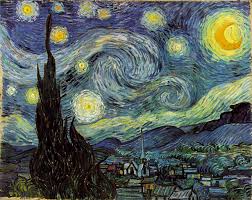
| Starry Night by Vincent Van Gogh |
|
A few months ago, Jeffrey Rankin, who is an Associate Dean in the Rutgers University, College of Engineering and serves as the Patriarch to our Stake, gave the following talk in one of our Branch sacrament meetings. While the topic of the talk was The Creation, I think that it is one of the best that I have heard on the general subject of science and religion.
The talk is published in our blog with his permission. As Jeffrey Rankin is the sole author of this article, it is not to be copied or distributed in any form or forum by anyone else without his written permission.
SACRAMENT MEETING TALK – East Brunswick
YSA Branch – January 29, 2012
“Things as They Really Are” (based on writings by Elder Neal
A. Maxwell)
========================================================
I. The Glory of the
Creation
I have had the opportunity to put my eye to the lens of
several astronomical telescopes and view the night sky. That experience, I think, strikes any serious
scientist, no matter his or her area of research, with a feeling of unequaled
wonder.
Putting our planet in perspective, Stephen Hawking, the
renowned physicist, wrote:
“The earth is a medium-sized planet orbiting around an
average star in the outer suburbs of an ordinary spiral galaxy, which is itself
only one of about a million million galaxies in the observable universe.”
When one looks at pictures of the Milky Way, our home
galaxy, the breathtaking view brings to mind the Lord’s words about His having
created “worlds without number” (Moses 1:33).
Continuing to investigate telescopic pictures of other galaxies, we can
recall the divine words that “there is no end to my works” (Moses 1:38). There are nebulae, like the Doradus Nebula,
which if it were as close to us as is very distant Orion, would literally cover
one-fourth of the night sky. Think of
the words about how God’s creations “cannot be numbered unto man, but they are
numbered unto [Him]” (Moses 1:37).
President Brigham Young said that God knows all things
pertaining to this earth and “He knows all things pertaining to millions of
earths like this one”. (Journal of Discourses 11:41). President Joseph Fielding Smith stated, “We
have brothers and sisters on other earths.
They look like us because they, too, are the children of God and were
created in His image….” (Doctrines of Salvation, 1:62).
When we contemplate the stunning vastness, it is wise to
remember “Behold…all things are created and made to bear record of me (Moses
6:63). Alma
declared, “All things denote there is a God…all the planets which move in their
regular form do witness that there is a Supreme Creator” (Alma 30:44).
Our universe is an overwhelming one and a witnessing one!
Reversing the lens in both reality and in thought, I have
also had the tremendous opportunity to look through microscopes so powerful
they can see to the atomic level. At the
other end of the spectrum of size we also see divine design in the tiny but
significant DNA molecule. This molecule
which performs so many large chores is formed by an intricate double,
intertwined helix consisting of hundreds of atoms arranged in significant governing
patterns.
The most important chemical in the world which is ever
present in my work and teaching is one of the simplest – water. It is, as simply constructed as it is,
probably the most unique in its properties.
If it behaved like nearly every liquid in the world, when water froze to
ice, it would become more dense, the solid ice sinking to the bottom of the remaining
liquid pool. If this were the case, our
planet would be literally a dead one, as ice would drop to the bottom of the
oceans never to be warmed again, leading to the cold grip of death on the fauna
and flora of our planet. One such as I
who have studied literally hundreds of compounds cannot help but be amazed that
such a simple molecule could be so critically different. Rather it has been designed so that its solid
phase is just a little less dense than the liquid and so it floats on the
surface to be the first to catch the warming rays of the sun, returning it to
its life-giving liquid form.
While I was pursuing doctorate work, I was once asked in a
public church meeting by an old dedicated high priest if I actually studied
chemical engineering by the Spirit. I
had never pondered that thought before and it took me back. I have since concluded that that is an all-important
question in light of the awesome power displayed in our natural universe.
=======================================================
II. Levels of Truth
The Lord sees no conflict between faith and learning in any
breadth of study.
D&C 88:78-79, 118:
“…that you
may be instructed more perfectly in theory, in principle, in doctrine, in the
law of the gospel, in all things that pertain unto the kingdom of God, that are
expedient for you to understand;
“Of things
both in heaven and in earth, and under the earth; things which have been,
things which are, things which must shortly come to pass; things which are at
home, things which are abroad; the wars and perplexities of the nations, and
the judgments which are on the land; and a knowledge also of countries and of
kingdoms…
“And as all
have not faith, seek ye diligently and teach one another words of wisdom; yea,
seek ye out of the best books words of wisdom; seek learning even by study and
also by faith.”
The scriptures tell us that the Lord sees faith and learning
as mutually facilitating, not separate processes.
We are commanded to seek truth. Truth is the highly and rightly valued result
of the learning process. There are,
however, gradations of truth. They are
not of equal significance. These
gradations might be represented geometrically by a wide, layered circle. You might imagine this as a layered cake with
tiers that decrease in diameter from bottom to top.
The bottom outer layer of the circle would include truths
which are by definition accurate descriptions of reality. But these would be facts such as train
schedules, monetary exchange rates, calendar dates, and so on. They are real. They have utility and they are relevant to
our daily lives, but they often have a very short shelf life. They cannot be ignored in this world, but
they are simply not on the same footing as other kinds of truth. I am sure you can think of lots of similar
and probably better illustrations.
The next concentric circle or cake layer inward would include
more important truths. These are
important, but not what we will call the ultimate truths. Some of these, for instance, are verifiable
by the very serviceable scientific method.
These truths can be very useful and valuable. For instance, in the realm of astrophysics,
they tell us much about the “what” and “how” of the universe, but they cannot
(and do not presume to) tell us “why” it exists.
In this same middle layer, the suburbs of the ultimate
truths, so to speak, there is a churning and revising among some of these
truths. Indeed life in the suburbs may
mean one can be “ever learning” but still “never able to come to a knowledge of
THE truth” as Paul stated to Timothy (2 Timothy 3:7). Even so, these truths are important and
valued.
Let me give you an example from personal study. I have been preparing class notes for a
course that I must teach involving one of the most exact mathematical sciences
known to us, that which we call Thermodynamics.
It is a useful science that has been at the heart of much technological
progress. Its first fundamental law
states that the energy content of the universe is constant. That means simply in the words of beginning
student that “you can’t get something for nothing”. Using energy to work change in one system
means that you must decrease the energy content somewhere else. The second law is even more restrictive. It deals with a property labeled Entropy
which would describe the disorder of the universe. Clausius formulated the law in these
terms: The entropy of the universe is
ever increasing. In the words of that
beginning student, “not only can’t you get something for nothing, you can’t
even break even.” Or, “if you think things
are messed up now, just wait awhile!”
These theories to organize scientific facts as we observe
them would tell us that the universe is winding down, slowly but surely. All things lead to a natural death of things
as we know them. Even as mankind acts to
improve his environment by harnessing the forces and materials of nature, he
forces an acceleration toward ultimate complete disorder where nothing can work
any longer.
Now contrast those ideas to such processes as “creation of
worlds without number” or “resurrection of the body to its perfect
condition.” Clearly we have much more to
add to these accepted scientific truths!
So in the very center of the circles of truth lie the “deep
things of God” (I Corinthians 2:10, 14).
These come to us only by revelation from God, and they clearly have a
greater significance than other truths and fleeting facts.
There is constancy, not churning, among these strategic
truths. These truths, for instance, are
revealed from God and tell us “why” the universe exists. They are also very personal and crucial. They represent the highest order of truth.
Stephen Hawking, displaying the meekness which is found in
all great scientists, wrote:
“Although science may solve the problem of how the universe
began, it cannot answer the question: Why does the universe bother to
exist? I don’t know the answer to that.
“What is the nature of the universe? What is our place in it and where did it and
we come from? Why is it the way it
is?...
“…If we do discover a complete theory,…then we shall all…be
able to take part in the discussion of the question of why it is that we and
the universe exist. If we find the
answer to that, it would be the ultimate triumph of human reason – for then we
would know the mind of God.”
Such questions are answered only by revelation, not solely
by reason. Certain high-grade knowledge,
as Paul taught, is “spiritually discerned” only (I Corinthians 2:14). Only when mind and spirit combine efforts can
we penetrate the inner circle realm of truth.
These truths are likewise verifiable. Jesus described how:
“If any man will do his will, he shall know of the doctrine,
whether it be of God, or whether I speak of myself.” (John 7:17)
Jesus is “the way, the truth, and the life” (John
14:6). Since He has received a fulness
of truth, we rightly seek to have the “mind of Christ” (D&C 93:26, 1
Corinthians 2:16). If we keep his
commandments, the promise is that we will receive “truth and light” until we
are “glorified in truth and [know] all things” (D&C 93:28). Would either a true scholar or disciple
settle for less?
Paul L. Holmer wrote, “We can also say that in living right,
we will also think right.”
III. What Is Real
The adverb “really” is used only twice in all of scripture,
and then only for exceptional emphasis.
In Jacob 4:13, the prophet Jacob underscored the manner in which the
Spirit teaches the truth.
“Behold, my brethren, he that prophesieth, let him prophesy
to the understanding of men; for the Spirit speaketh the truth and lieth
not. Wherefore, it speaketh of things as
they really are, and of things as they really will be; wherefore, these things
are manifested unto us plainly, for the salvation of our souls.”
Jacob’s declaration about truth is consistent with the
definition of truth given by the Lord to Joseph Smith.
“And truth is knowledge of things as they are, and as they
were, and as they are to come.”
(D&C 93:24)
The true religion believer is actually the ultimate realist,
for he has a fully realistic view of man and of the universe. He traffics in truths that are culminating
and everlasting. He believes as the Lord
has said “…truth abideth and hath no end.” (D&C 88:66)
What are the special and central and overarching truths that
are numbered among “things as they really are”?
1. There is a true
and living God.
2. There is a true
and living Church.
3. There are true and
living prophets.
4. There are true and
living scriptures.
It is the “living-ness” of these incredibly important
realities that separates them from transitory things, from dying things, from
local beliefs, or from short-lived theories that do not maintain themselves
over time.
IV. Understanding
Reality Gives Us Perspective
Much of really living consists of aquiring perspective about
everlasting truths so that we can manage the transitory factual things. To experience real freedom as Jesus spoke of,
for “the truth shall make you free” (John 8:32) we must understand that certain
deep truths are to obtained only through the Spirit of our Heavenly
Father. Paul stated “the Spirit
searcheth all things, yea, the deep things of God.” (I Corinthians 2:10) But “the deep things of God” are understood
only as we come to know about things as they really are. Such knowledge is of inestimable worth.
Would we ask someone who is in a jet flying over Europe to adjust to the culture and language of each
country whose airspace he is over at the moment? We would not.
Likewise the disciple of Christ knows in reality that he is only briefly
in but not of this world; it is not his destination, for he follows the living
God of the galaxies. The ways of this
world are, in factual perspective, alien to the better world he seeks to
prepare for. He will be truly realistic,
for to be too quick to adjust and accept the ways of this world is to be
maladjusted and ill prepared for the next.
It is vital to know therefore about things as they really are in order
to have proper perspective for our choices.
It is vital to know that there REALLY is a God, that there
REALLY is a Savior, Jesus Christ, that there REALLY is impending immortality
for all men, that there REALLY will be a judgment with genuine personal
accountability, and that there REALLY is purpose in life and a divine plan for
happiness for man. These truths are a
special kind of knowledge – “of things as they really are and of things as they
really will be – which keeps us from being tossed to and fro by mere
theories. These are the truths that
will make us free.
With true perspective comes a sense of proportion about
life. It helps us with our
priorities. For instance, understanding
a true perspective, clearly one would not forgo partaking of the sacrament
because he is trying to lose weight. Yet
some neglect the scriptures because they are too busy minding the cares of the
world. Knowing how things really are
permits us to test all mortal suppositions so we won’t be victimized by
fleeting and tempting tradeoffs proffered by mortal men. Coming to see things as they really are will
of course make one a member of a minority, one that is sometimes despised. We could scarcely endure taking up the
crosses of the world without knowing the truth of things as they really are.
Do you remember the great and spacious building in the Book
of Mormon in Lehi’s dream which we just studied in gospel doctrine class? The trendy, self-congratulating multitudes
mocked and pointed at those who clung to the gospel’s iron rod. A few whose hands had once grasped the iron
rod ended up in the great and spacious building pointing their own fingers of
scorn at former friends. Strange is it
seems, the scriptures do not indicate that these individuals let go of the iron
rod for any objective reasons or because they were in truth intellectually
persuaded by the views of those in the building. They were simply ashamed and embarrassed to
be separated from the worldly multitudes, whose contempt they could not
endure. Nephi saw that “after they had
partaken of the fruit of the tree they did cast their eyes about as if they
were ashamed.” (1 Nephi 8:25)
Being true to what we know about things as they really are
takes immense integrity and constant courage.
Things as they really are require the believer to be at his best – to be
what he really could be, and also to understand who he really is.
V. Vastness of
Creation vs. Individual Attention of God
Amid the cosmic vastness overseen by God and Jesus, we can
also have faith in their loving personal-ness.
We want to be assured that God is there and also to know what He is
like. We yearn to know what His and
life’s purposes are. Does He really know
us and really care about us individually?
The reassuring reality was confirmed in Enoch’s exclamation:
“And were it possible that man could number the particles of
the earth, yea, millions of earths like this, it would not be a beginning to
the number of thy creations; and thy curtains are stretched out still; and yet
thou art there, and thy bosom is there; and also thou art just; thou art
merciful and kind forever” (Moses 7:30).
The most important thing for meek Enoch to know as not how
many worlds there were, but that God was really there! Enoch also learned that God is just, true,
merciful, and kind. We have an example
in the Lord. Will we, however, follow
His example?
God is in the details of the galaxies, of the DNA molecule,
but, even more importantly, He is in the details of our individual lives.
VI. The
Scholar-Disciple
For a disciple of Jesus Christ, academic scholarship is a
form of worship. It is actually another
dimension of consecration. One who seeks
to be a disciple-scholar will take both scholarship and discipleship seriously
and therefore likewise gospel covenants.
For the disciple-scholar, the first and second great commandments frame
and prioritize life. How else could one
worship God with all of one’s heart, MIND, and strength? (Luke 10:27)
The disciple-scholar also understands what kind of community
he or she should help to build. Its
citizens openly and genuinely desire to be called God’s people. They are not secret disciples, but bear one
another’s burdens, mourn with those that mourn, comfort those in need of
comfort, and witness for God at all times, and in all places, and in all things
(Mosiah 18:8-9). Intellectual pride
reflects the way of hell, not of heaven.
It is no wonder that a true community of scholars would qualify to be a
part of the larger community of Saints.
The disciple-scholar also understands Jesus’ style of
leadership, which includes persuasion, long-suffering, gentleness, meekness,
love unfeigned, kindness, pure knowledge – all being achieved without hypocrisy
and guile. (D&C 121:41-42, Mosiah
3:19)
It is meekness which facilitates working on what is lacking
in each of our characters. For
instance, the rich, righteous young man, otherwise clearly a high achiever, who
came to Jesus asking what he might do to have eternal life, was told “One thing
thou lackest” (Mark 10:21). His lack was
not of marketplace business ability or of honesty in business affairs; instead,
he lacked meekness. This unfortunately
kept him from doing that customized thing which Jesus asked him to do – sell
all that he had, give to the poor, and come follow Him. The young man lacked consecration.
If we are to be true disciples, we can be assured that Jesus
will ask us to do works and meet challenges that He has customized for us according
to what we lack, each being different.
As Michael Polyani noted, “To learn by example is to submit to
authority”. The key attribute of the
disciple-scholar is meekness.
Ponder what Brigham Young said of his tutorial relationship
with Joseph Smith:
“An angel never watched [Joseph] closer than I did, and that
is what has given me the knowledge I have today. I treasure it up, and ask the Father, in the
name of Jesus, to help my memory when information is wanted.”
If knowledge is truly power, how can he who possesses
absolute truth be considerate of others?
Obviously the answer is for truth to be accompanied by love and
meekness, as exemplified for us in the character of Jesus. Power is safest, therefore, with those most
Christlike, and heaven’s power is accessible only to such individuals.
Genius is safest when it is accompanied by meekness. Competency is most useful when accompanied by
humility. The qualities of love, mercy,
patience, meekness, and spiritual submissiveness are eternally portable. These – to the degree they are developed –
will go with us through the veil of death; they will also rise with us in the
resurrection.
VII. Testimony of the
Reality of God and His Love for Us Individually